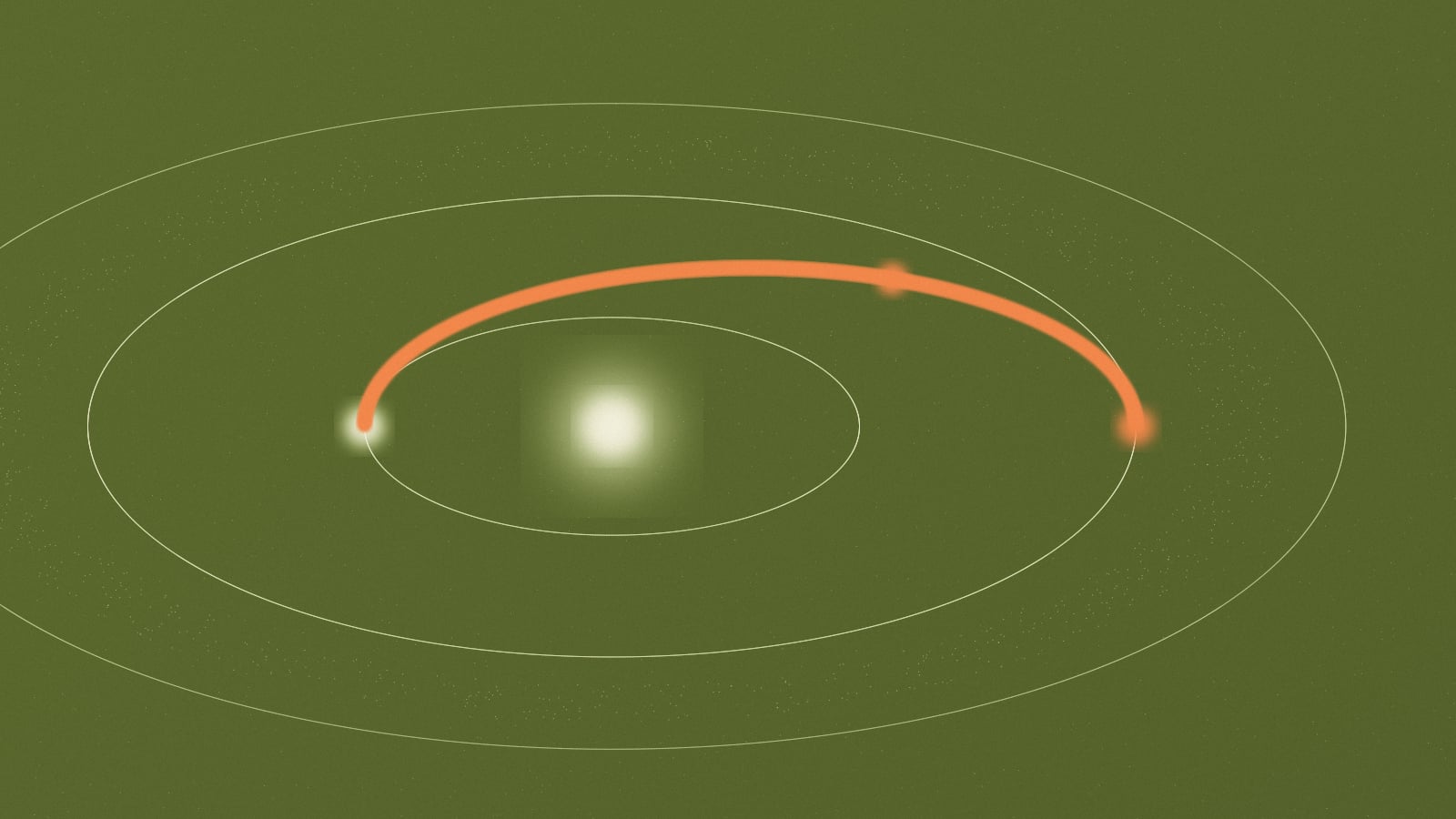
Humanity's expansion beyond Earth isn't science fiction - it's active engineering. Across NASA, ESA, private companies, and research institutions worldwide, scientists are developing the technologies that will carry humans to Mars and beyond. The peer-reviewed literature reveals how close we are to solutions once considered impossible.
Propulsion: The Tyranny of the Rocket Equation
Every deep space mission faces the same fundamental constraint: the Tsiolkovsky rocket equation. To go faster, you need more fuel - but more fuel means more mass, requiring even more fuel. Breaking this cycle demands revolutionary propulsion.
Nuclear Thermal Propulsion (NTP)
NASA's renewed interest in nuclear thermal propulsion stems from one compelling fact: NTP could cut Mars transit time from 7-9 months to approximately 100 days.
| Propulsion type | Specific impulse | Mars transit |
|---|---|---|
| Chemical (LOX/LH2) | ~450 seconds | 7 to 9 months |
| Nuclear thermal | ~900 seconds | 3 to 4 months |
| Nuclear electric | ~5000 seconds | 2 to 3 months (cargo) |
According to NASA's Space Technology Mission Directorate, the DRACO (Demonstration Rocket for Agile Cislunar Operations) program aims to demonstrate NTP technology by 2027 - the first nuclear thermal engine test in space since 1972.
"Nuclear thermal propulsion can provide high thrust at two to three times the specific impulse of the best chemical rockets." - NASA NTP Program Office
Ion Propulsion: Slow and Steady
Ion engines produce tiny thrust but extraordinary efficiency. Research dating to Kluever's 1997 heliospheric studies demonstrated that ion propulsion enables missions impossible with chemical rockets:
| Mission | Propulsion | Achievement |
|---|---|---|
| Deep Space 1 | NSTAR ion | First interplanetary ion mission |
| Dawn | Ion (xenon) | Orbited two bodies (Vesta, Ceres) |
| BepiColombo | Ion | En route to Mercury orbit |
| Psyche | Hall-effect | Asteroid rendezvous underway |
Ion and chemical propulsion
Filled: the high or long side of each row.
Solar Sails: Riding Light
The LightSail 2 mission demonstrated controlled solar sailing in Earth orbit. Japan's IKAROS and the upcoming NASA NEA Scout represent the next evolution: propellantless propulsion using photon pressure.
Life Support: Closing the Loop
A Mars mission requires life support systems that recycle nearly everything. The International Space Station achieves about 90% water recovery, but Mars demands better.
Solid Oxide Electrolysis
A 2025 study by Macdonald et al. describes integrating solid oxide co-electrolysis into closed-loop life support:
Future closed-loop life support
- CO₂ExhaledH₂OWaste
- Solid oxide co-electrolysisHigh-temperature ceramic electrochemical cells
- The O₂ from both streams becomes breathing oxygenCO + O₂H₂ + O₂
- Sabatier reactor
- CH₄ + H₂OMethane fuel and recovered water
Methane-Based Systems
Zheleznyakov et al. (2021) at the Russian Academy of Sciences demonstrated methane's role in closed-loop systems - particularly relevant since SpaceX's Starship uses methane fuel, enabling potential in-situ propellant production on Mars.
Current vs. Future Recovery Rates
| Resource | ISS Current | Mars Mission Target |
|---|---|---|
| Water | ~90% | >98% |
| Oxygen | ~42% (from CO₂) | >95% |
| Waste biomass | ~0% | >80% (composting) |
| Atmosphere | Partial | Full recirculation |
Radiation Protection: The Invisible Killer
Outside Earth's magnetosphere, astronauts face two radiation threats: solar particle events (SPEs) from the Sun and galactic cosmic rays (GCRs) from deep space.
The Challenge Quantified
| Radiation Source | Dose Rate | Comparison |
|---|---|---|
| Earth surface | 0.1 mSv/year | Baseline |
| ISS (LEO) | ~150 mSv/year | Earth's field partially shields |
| Lunar surface | ~380 mSv/year | No magnetic protection |
| Mars transit | ~300 mSv/year | Full GCR exposure |
| Mars surface | ~200 mSv/year | Thin atmosphere provides some shielding |
NASA's lifetime limit for astronauts is 600 mSv. A Mars mission could approach this in a single journey.
Advanced Shielding Materials
A 2025 study by Patel et al. at NASA Langley describes boron nitride nanotube-reinforced polyethylene for neutron shielding:
"BNNT-reinforced polyethylene composites demonstrate superior neutron attenuation compared to conventional materials while maintaining structural integrity for spacecraft construction."
Bahadori et al. (2017) at NASA's Johnson Space Center established standardized methods for measuring shielding effectiveness, enabling comparison across materials:
Radiation shielding effectiveness
Filled cells show relative mass efficiency.
Multi-Layer Protection Strategy
Future deep space vehicles will likely combine approaches:
- Structural shielding: BNNT composites in hull
- Water walls: Consumable water surrounding crew quarters
- Storm shelters: Heavily shielded areas for solar events
- Active monitoring: Real-time dosimetry and event prediction
In-Situ Resource Utilization: Living Off the Land
Launching everything from Earth is prohibitively expensive. The solution: make what you need where you are.
Lunar ISRU Progress
A 2025 study by Aiyeki et al. demonstrated 3D printing with lunar regolith simulant using digital light processing:
Lunar construction ISRU pipeline
- Lunar regolithSurface soil
- Robot excavation and collection
- Sintering or meltingYields 3D printed structures and componentsChemical extractionYields oxygen, metals and water
Suzuki et al. (2025) explored molten regolith-salt systems applicable to both Moon and Mars, enabling metal extraction and construction material production.
Mars ISRU: The MOXIE Demonstration
NASA's MOXIE experiment on Perseverance successfully extracted oxygen from the Martian atmosphere - proving that the 96% CO₂ atmosphere can be converted to breathable oxygen and rocket oxidizer.
| ISRU Application | Moon | Mars |
|---|---|---|
| Oxygen | From regolith | From atmosphere (CO₂) |
| Water | Polar ice deposits | Subsurface ice |
| Propellant | LOX from regolith | Methane + LOX (Sabatier) |
| Construction | Sintered regolith | Processed regolith |
| Metals | Iron, titanium, aluminum | Iron-rich minerals |
Reusable Systems: The Economics Revolution
SpaceX's Falcon 9 demonstrated that rocket reusability fundamentally changes space economics:
Launch cost to LEO, $ per kg
Starship: The Mars Vehicle
SpaceX's Starship represents the most ambitious reusable system ever attempted:
| Specification | Value | Significance |
|---|---|---|
| Payload to LEO | 100-150 tonnes | Largest ever |
| Payload to Mars | 100+ tonnes | Enables settlement |
| Reusability | Full (both stages) | <$10M per launch target |
| Propellant | Methane/LOX | ISRU-compatible on Mars |
Communication: Talking Across the Solar System
The Light-Speed Delay Problem
| Distance | One-Way Delay | Round-Trip |
|---|---|---|
| Moon | 1.3 seconds | 2.6 seconds |
| Mars (closest) | 3 minutes | 6 minutes |
| Mars (farthest) | 22 minutes | 44 minutes |
| Jupiter | 33-53 minutes | 66-106 minutes |
Laser Communications
NASA's LCRD (Laser Communications Relay Demonstration) proved optical communication works, achieving data rates 10-100x higher than radio:
| Technology | Data rate | Status |
|---|---|---|
| Deep Space Network (radio) | ~10 Mbps (near), ~100 kbps (Mars) | Operational |
| Laser (optical) | ~100 Mbps (Moon), ~1 Gbps (LEO) | Demonstrated |
| Optical (future) | ~1 Gbps (Mars) | Development |
Timeline: The Path Forward
Based on current development trajectories and announced programs:
Human space exploration roadmap
2025 to 2030
- Artemis III: first woman on the Moon
- Lunar Gateway construction begins
- DRACO NTP demonstration
- Starship orbital operations mature
2030 to 2040
- Sustained lunar presence
- Lunar ISRU operational
- First crewed Mars mission, orbital or landing
- Commercial space stations replace the ISS
2040 to 2050
- Mars surface operations
- Mars ISRU for propellant production
- Return missions become routine
- First permanent Mars habitat
2050 and beyond
- Mars settlement expansion
- Asteroid mining operations
- Outer planet robotic exploration with advanced propulsion
- First interstellar probes launched
Conclusion
The technologies for reaching Mars and establishing permanent human presence beyond Earth are no longer theoretical - they're in active development. Nuclear thermal propulsion will cut transit times to manageable durations. Advanced life support systems will close the resource loop. Novel radiation shielding will protect crews from cosmic hazards. In-situ resource utilization will enable living off the land.
The peer-reviewed literature demonstrates consistent progress across all critical technologies. The question is no longer whether humans will live on other worlds, but when - and the research suggests the answer may be within our lifetimes.
The stars aren't beyond our reach. They're our destination. And the engineering to get there is already underway.
This article cites peer-reviewed research from Semantic Scholar and NASA technical publications. For complete bibliographic information, see the hyperlinked references throughout the text.
Sources13 linked references
- 1.Tsiolkovsky rocket equation
- 2.NASA's Space Technology Mission Directorate
- 3.NASA NTP Program Office
- 4.Kluever's 1997 heliospheric studies
- 5.LightSail 2 mission
- 6.NASA NEA Scout
- 7.2025 study by Macdonald et al.
- 8.Zheleznyakov et al. (2021)
- 9.2025 study by Patel et al.
- 10.Bahadori et al. (2017)
- 11.2025 study by Aiyeki et al.
- 12.Suzuki et al. (2025)
- 13.LCRD (Laser Communications Relay Demonstration)